Simply short
Finland’s economy heading out of recession
Finland’s economy is turning the corner, but slowly. Households are bringing their finances into balance, and consumption is starting to grow. Exports and investments will gradually pick up. When growth in the economy strengthens, employment will also improve. Inflation will remain moderate in the next few years. Public spending will persistently exceed revenues, which means that public debt will increase further.
The Finnish economy’s recovery from recession has been slow. The confidence of households and businesses in the future has been at a low level, making them cautious about consuming and investing. Uncertainty is persisting for many reasons, such as the challenging financial situation of central and local government, high unemployment, the trade war initiated by the United States, and global political events.
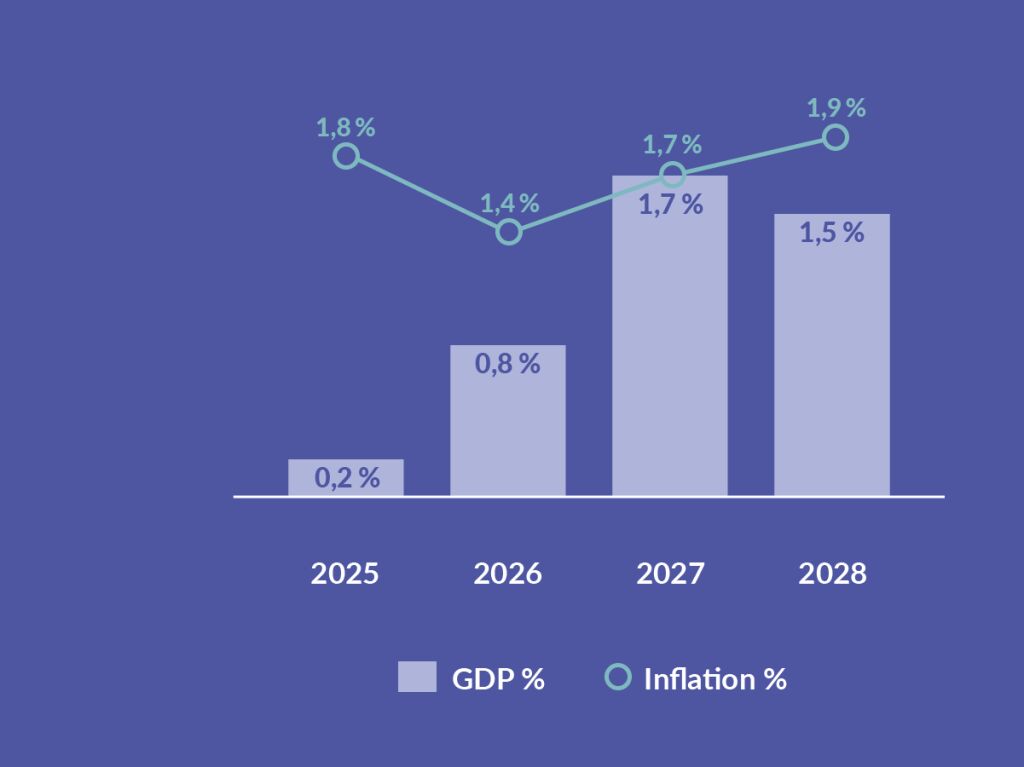
Finland’s economic output is nevertheless forecast to grow by almost 1% in 2026. The country’s exports will grow in the wake of growth in the economies of its export markets. So far, the trade war impact on Finnish exports appears to have been minor. However, the uncertainty connected with the trade war and global politics has not faded entirely.
Employees’ incomes will grow and inflation will stay low. Private consumption will increase as households bring their income and spending into closer balance. Business investment will also start to rise. This will be seen in, for instance, green transition projects, such as wind power, and in data centre investments.
Growth in the Finnish economy will climb to approximately 1.5% in the years 2027 and 2028. The improving economic conditions will start to be seen clearly in the labour market too. The number of people in employment will rise and this will further boost incomes and consumption growth. The growth in business investment will continue. The deep paralysis in the housing market will also begin to ease as household confidence improves. Housing construction growth will nevertheless remain subdued in the immediate years ahead.
Export growth will continue in 2027 and 2028. In Finland’s main export markets, investment will increase as a result of market rates being lower than in recent years, and this will boost demand for the export of Finnish capital goods. Imports will also grow briskly. A significant factor in this will be the import of new fighter jets for the Finnish Defence Forces.
The rate of inflation in Finland has fallen to about 1.5%. The rising economic growth will push up the inflation rate a little, but inflation will nonetheless stay below 2% in the years of the forecast.
In Finland’s public finances, the amount of public debt will continue to increase in the immediate years ahead. Central and local government expenditure will remain persistently higher than revenues, even despite the public spending cuts and the higher tax revenues as the economy grows.