Forecast
Alternative scenario
Analysing the impact of alternative energy price scenarios on the Finnish economy

Jaakko Nelimarkka
Senior Economist
Harri Pönkä
Senior EconomistThe war in Iran is having a considerable impact on energy prices and the global economy. This article presents different scenarios that complement the Bank of Finland’s June 2026 baseline forecast and draw attention to the risks associated with rising energy prices. According to the analyses, higher energy prices that remain above those of the baseline scenario would lead to lower economic growth and higher inflation in Finland, especially in 2027. On the other hand, if the later fall in energy prices were to be steeper than is assumed in the baseline and confidence in the economy were to improve, output would be higher and inflation lower than in the baseline scenario.
Energy prices rose sharply in March 2026 after the Middle East crisis began. The price of Brent crude oil, the benchmark, rose from just over USD 60 before the crisis to around USD 100 per barrel. Similarly, the price of natural gas went up in the euro area from about EUR 30 to nearly EUR 50 per megawatt hour. The crisis has also caused disruptions in the supply and availability of energy. In Finland and the euro area, the impacts of the crisis are primarily connected to higher energy prices. The price of imported energy used in Finnish production was approximately 50% higher in April than at the end of 2025. However, the fact that Finland’s electricity production is largely independent of fossil fuels ameliorates the economic impacts of rising energy prices.
The rise in global energy prices will affect the Finnish economy in various ways. Firstly, production costs will increase, output will decline and companies will raise prices. The impact on competitiveness will depend on export price trends in competitor countries. Secondly, rising energy prices will raise consumer prices, erode households’ real purchasing power and reduce consumption. Thirdly, rising energy prices will have a negative impact on the global economy, reducing Finland’s external demand and exports. In addition, the heightened geopolitical tension and rise in energy prices can cause uncertainty, potentially slowing consumption and investment.
Middle East conflict could further raise energy prices
The energy price rises realised so far are included in the baseline scenario of the Bank of Finland’s June forecast, and the assumption is made that energy prices will develop in line with market expectations (Chart 1). However, energy prices will probably continue to fluctuate significantly in the future as well, and their trend will depend on global political events that are difficult to predict. This article presents two sensitivity analyses which assess the impacts of changes in energy prices on the Finnish economy. The analyses were prepared using the Bank of Finland’s Aino model.1
The analyses examine how changes in the prices of energy and food raw materials affect the economy. In addition to direct impacts, the analyses also take into account changes in uncertainty and the way in which price increases are transmitted to the Finnish economy through foreign trade. The analyses assume that monetary and fiscal policy will remain unchanged. With some minor exceptions, the assumptions in the analyses are the same as in the European Central Bank’s (ECB) ‘milder’ and ‘adverse’ scenarios for the euro area. The ECB projections also include a ‘severe’ scenario in which inflation is higher and economic growth lower than in the adverse scenario. The effects on the Finnish economy would be qualitatively similar to those on the euro area.
The first sensitivity analysis is an adverse scenario in which energy prices rise by about 20% compared with the trajectory for current market expectations over the entire duration of the forecast period (Chart 1).2 In addition to energy, the prices of raw materials and imported goods, such as fertilisers and food, will also rise.3 Finland’s export demand is assumed to decline and competitor countries’ export prices to rise in line with the ECB’s adverse scenario for the euro area. In addition to the impact on energy and raw materials prices, the crisis would increase uncertainty in the financial markets regarding future developments, which is included in the analysis as a factor slowing economic growth.
chart 1.Energy prices vary in different scenarios
The second sensitivity analysis is a milder scenario in which energy prices are assumed to fall and uncertainty to decrease. In the milder scenario, energy prices would be 15%–20% lower than in the June 2026 forecast (Chart 1).4 The increase in the prices of raw materials and imported goods would not materialise, and the outlook for Finland’s export markets would be more favourable. An easing of the crisis would also lead to stronger consumer confidence in Finland.
Higher energy prices would push up inflation and hinder economic growth
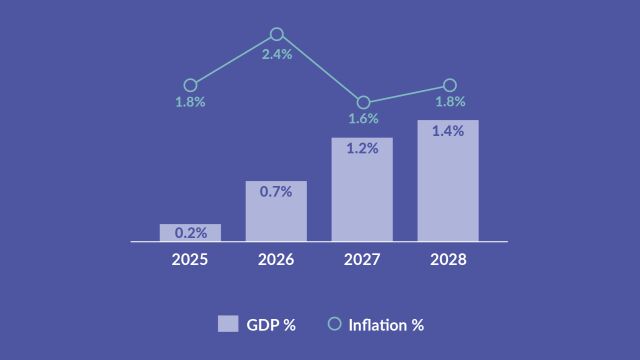
In the adverse scenario, a sharp rise in the prices of energy and raw materials would lead to slower economic growth (Chart 2) and higher inflation (Chart 3) than under the baseline scenario of the forecast. Higher energy prices would eventually feed through to the economy: growth in gross domestic product (GDP) would slow down the most in 2027. A relatively permanent rise in energy prices would also have a strong and long-term inflationary impact which would be mainly focused on 2027. While an increase in energy prices would raise consumer prices immediately, it would also be passed on to other consumer prices from 2027 onwards.5
chart 2.Higher rise in energy prices would lead to lower economic growth
In contrast, under the milder scenario, the energy market would calm down, prices would fall more quickly than expected (Chart 1) and household consumption intentions would strengthen in Finland.6 In this case, annual GDP growth would be around 0.2 percentage points higher than the baseline figure (Chart 2), and the rise in consumer prices would be more moderate than in the baseline (Chart 3).
chart 3.Inflation depends on energy prices
Changes in energy prices affect the Finnish economy especially through foreign trade (Chart 4). These impacts stem from changes in Finland’s external demand and in trading partners’ export prices. Under the adverse scenario, the former would contract and the latter rise, which would also increase production costs in Finland. Under the milder scenario, the effect of foreign trade would be the reverse of this.7
Through foreign trade, higher energy prices would have a slowing effect of about 0.2 percentage points on annual GDP growth in 2027–2028. On the other hand, the direct impact of energy and raw material prices on companies’ activity and consumption would be just 0.1 percentage points. If higher energy prices lead to an increase in uncertainty, they would also slow economic growth, especially in the first half of the forecast period. A similar effect in the opposite direction is seen in the milder scenario, under which lower energy prices would improve external demand and household confidence, boost household purchasing power and reduce business costs.
chart 4.Changes in energy prices are transmitted through foreign trade
On the other hand, energy prices have a direct impact on consumer prices, and this would be evident in the first year (Chart 5). The transmission of higher energy prices to other consumer prices will in turn push up inflation in 2027. In the milder trajectory, inflation would slow down. However, in this case the improvement in external demand would have a slight upward impact on inflation as domestic demand increases due to income growth.
chart 5.Energy prices have a direct impact on inflation
Notes
-
In addition to the Aino model, the analyses use short-term inflation models to assess the effects of rising energy prices on inflation in the short term.
↑ -
Oil and natural gas are traded on the futures market, and the related option prices can be used to derive a market expectation distribution that reflects uncertainty over future prices. The increase in energy prices in the adverse scenario corresponds to a situation in which natural gas and oil prices equate to the 75th percentile of the market expectation distribution. A percentile is a statistical indicator depicting the proportion of the observations data falling below a certain value. In other words, the energy price increase corresponds to a scenario in which natural gas and oil prices follow a market expectation trajectory in which approximately 75% of all oil price quotations made on 21 May 2026 fall below this boundary.
↑ -
In the analysis, the prices of other industrial raw materials will rise by just under 9% compared with the baseline level. The increase in industrial raw material prices is based on the weighting of food raw materials in the industrial raw material index.
↑ -
This corresponds to a situation in which oil and natural gas prices would equate to the 25th percentile of market expectations calculated on the basis of option prices on 21 May 2026. See also footnote 3.
↑ -
The Bank of Finland’s March 2026 forecast also examined an alternative in which the rise in energy prices would remain temporary. The effects of abruptly rising and then declining prices of energy and raw materials on inflation and economic growth would be temporary and smaller in this case.
↑ -
The milder scenario differs from the ECB’s milder scenario for the euro area in that the scenario concerning Finland assumes an improvement in confidence.
↑ -
The analysis also includes the indirect effects, i.e. general equilibrium effects, arising through various channels. For instance, the direct effects of foreign trade relate to changes in companies’ external demand and import prices. Indirect effects arise from the reactions of, for example, households, when companies adjust their output, labour force and prices. In addition, changes in competitors’ export prices affect Finland’s competitiveness, but the effect is minor in the analysis.
↑